FO-C-US field notes · relationships and a life well lived
The people we love keep getting what is left of us
We call relationships important, then organise our days as if they can survive indefinitely on postponed attention.
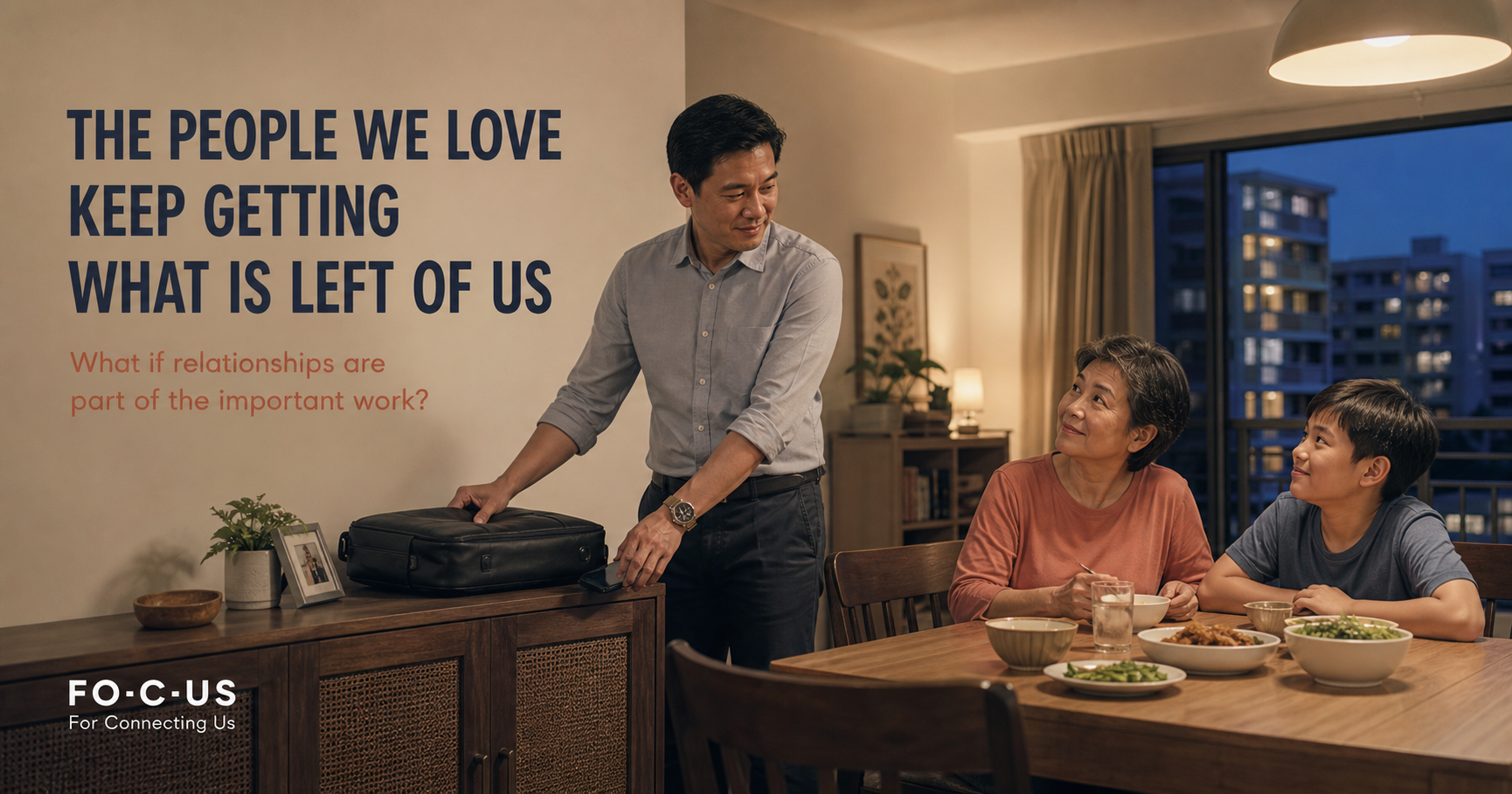
We know exactly where the important things go in a calendar.
The meeting is protected. The deadline has reminders. The appointment cannot be moved. The bill must be paid before midnight.
Then someone we love asks whether we have time to sit for a while, and we offer the most honest answer available: maybe later.
Later is not a lie. We intend to call our parents when work becomes less demanding. We will ask our partner the unhurried question after this difficult week. We will see the old friend when life settles down. We will listen properly to the child once the urgent thing is finished.
The urgent thing finishes. Another arrives.
Years can be built from that exchange: the world receives our alertness, discipline and best problem-solving; the people who make the effort worthwhile receive the version of us that comes home depleted.
Perhaps relationships are not the reward waiting after the important work. Perhaps they are part of the important work—and life keeps showing us this only after a moment has become a memory.
We do not usually lose closeness in one decision. We spend it slowly, in all the moments when something else seemed more urgent.
Relationships are not the background of a successful life
Achievement is easy to count. A promotion changes a title. A completed project produces an artefact. Money enters an account. Fitness appears in numbers.
The work of a relationship is harder to see. You answer when someone calls with no impressive news. You remember what they were worried about. You stay for the second version of the story. You repair the joke that landed badly. You become familiar with a person without deciding you already know them.
None of this looks productive while it is happening. Yet these repeated acts determine whether another human being experiences you as dependable, interested and safe.
A life can therefore look full from the outside while becoming relationally thin. There are tasks everywhere and nobody left who knows what completing them has cost.
The question is not whether ambition, responsibility or solitude matter. They do. It is whether our schedules reveal a belief we would never say aloud: that the people closest to us will continue to feel close without receiving time in which closeness can happen.
Love may feel permanent. The experience of being loved is built from perishable moments.
What research suggests about relationships and health
The association between social relationships and health is substantial, but it is often translated into headlines more confidently than the underlying research allows.
A landmark meta-analysis combined 148 studies involving 308,849 participants. Across an average follow-up of about seven and a half years, people with stronger social relationships had 50% higher odds of survival than those with weaker relationships. Measures capturing social integration showed stronger associations than a simple indicator such as living alone.
That finding does not mean friendship is a medicine with a guaranteed dose response. The included evidence was largely observational. Health can shape social participation, and unmeasured differences may affect both relationships and survival. The analysis shows a robust association across many populations; it does not prove that adding one dinner or phone call extends a life.
A newer meta-analysis of 90 prospective cohort studies, covering more than 2.2 million adults, found that both social isolation and loneliness were associated with higher all-cause mortality. Isolation and loneliness are related but different: one concerns the structure of contact, the other the felt experience of disconnection.
This distinction matters. A person can live alone and feel held by a community. Another can be surrounded by family and feel unseen. Counting contacts cannot tell us whether a relationship restores or exhausts the people inside it.
Research can show that social connection travels with health. It cannot reduce the meaning of another person to a risk factor we should manage.
The happiest people are not happy all the time
In a frequently cited study, researchers screened 222 university students and compared the consistently happiest 10% with average and very unhappy groups. The happiest participants were highly social and reported stronger romantic and other relationships.
No single characteristic guaranteed happiness. The happiest group still experienced negative moods. Their relationships did not protect them from the full range of being human.
This is a useful correction to the fantasy that a good relationship should keep us continuously comfortable. Important relationships disappoint, demand, interrupt and expose us. They also give joy somewhere to land and pain somewhere to be witnessed.
Perhaps relationships matter not because they remove difficulty, but because they change the experience of carrying it. Success becomes shareable. Failure stops being entirely private. A frightening decision can be spoken before it is solved.
Who currently knows the unedited version of your life—not merely the outcome, but the uncertainty that came before it? And whose uncertainty have you made room to know?
Not every relationship is good simply because it exists
Advice about the importance of relationships can become cruel when it assumes every family, friendship or partnership is safe.
Relationships can contain control, humiliation, neglect, violence and chronic strain. Loneliness can happen inside them. Distance from a harmful person may be an act of health, not a failure of connection.
Longitudinal evidence also points toward this complexity. A study using three waves of the Midlife in the United States project examined family and intimate-partner support and strain over twenty years. Family strain was associated with later morbidity and health appraisal, while health also predicted later family emotional climate. The pathways were reciprocal, and the results for intimate partnerships did not follow the same pattern.
The lesson is not that one relationship type matters more in every life. It is that the category “relationship” contains both care and strain, often at the same time. Quality, history and context matter.
FO-C-US is not an instruction to remain available to everyone. It is an invitation to recognise the people with whom mutual care is possible—and to stop treating that possibility as self-renewing.
Some relationships begin smaller than we expect
When people hear that relationships matter, they may think first of finding a perfect partner or repairing every family wound. That scale can make connection feel unavailable.
Experiments with train and bus commuters offer a smaller possibility. Participants assigned to talk with a stranger reported a more positive—and no less productive—journey than those assigned to remain disconnected. Beforehand, people tended to predict solitude would feel better.
A pleasant commute is not a close relationship, and the experiments do not suggest approaching someone who wants privacy. They show how easily we can mispredict the emotional result of modest social contact.
A relationship-rich life is not built only from profound conversations. It also grows through recognition: greeting the neighbour, learning the cleaner’s name, asking the colleague one question beyond the task, allowing the person serving kopi to become visible as a person.
Not every exchange becomes friendship. It can still make the social world feel less like a collection of obstacles and more like a place inhabited together.
What Singapore evidence can—and cannot—tell us
Singapore’s Family Trends Report 2025 cites national Quality of Life findings in which people who were satisfied with family support and happy with family relationships had significantly higher average quality-of-life scores than those who were not.
The same report found that 60.6% of respondents said they were happy with their family relationships and 55.7% were satisfied with family support. These are broad national indicators, not measures of depth, attention or face-to-face communication.
The direction of influence is also unresolved. Supportive families may contribute to quality of life; people with better health and resources may also find relationships easier to sustain. A statistical association cannot tell us what produced the experience in one home.
What the findings do offer is public context for a private question. If relationships and quality of life move together, what would it mean to design everyday life so that relationships receive more than our residual time?
A priority is visible before it is declared
Most of us do not need to be convinced that relationships matter. We need to confront the gap between what we believe and what our days repeatedly reward.
The gap is rarely selfishness. Work pays for the home in which relationships live. Caregiving can consume the energy it expresses. Rest is necessary. Sometimes survival leaves almost nothing to allocate.
But there are also moments when “busy” describes not an absolute lack of time, but a pattern of protected and unprotected claims. Other commitments receive a start time. Relationships receive good intentions.
Look at the coming seven days. Where is the evidence that another person—not their need, task or crisis, but the relationship itself—has a place?
If the answer is nowhere, the purpose is not guilt. Guilt often spends more energy on self-judgment than on change. The purpose is to make one belief visible in one decision.
The calendar cannot measure love. It can reveal whether love has somewhere to happen.
Choose one relationship before choosing a new routine
Do not begin with a promise to become a more connected person. Choose one person you do not want to know only through updates.
- 01Name the relationship
Write down one person and why this relationship matters beyond obligation or history.
- 02Notice what has gone missing
Is it play, curiosity, affection, honesty, shared memory—or simply unhurried presence?
- 03Make a bounded invitation
Try, “Could we have thirty minutes together this week? Nothing is wrong. I do not want us to keep postponing each other.”
- 04Ask for their present life
Begin with, “What part of your life do I know least about at the moment?”
- 05Offer your own answer
Do not make the other person perform closeness alone. Share what they may no longer know about you.
- 06Protect the return
Before leaving, decide on one small point of return—a walk, a meal, a call or a date already placed on the calendar.
If the invitation is not welcomed, respect the answer. Mutuality cannot be forced. Care can leave a door open without insisting that another person walk through it.
The work will never announce that it is finished
There may never be a season in which every task is complete and all our best energy can finally be given to the people we love.
This is not because modern life is uniquely broken. It is because human responsibility expands to occupy the space offered to it. There is always something legitimate left to do.
Relationships therefore cannot survive on the promise of surplus. They require chosen interruption: a moment in which useful activity gives way to a person whose value cannot be demonstrated by what the moment produces.
One day, the deadline that dominated this week will be difficult to remember. The people beside us will have changed. Some will no longer be available to call later.
We cannot attend to everyone, repair everything or turn every meal into a memory. We can stop assuming the relationships that make life meaningful should live on what life leaves behind.
The people we love are not waiting beyond the important work. They are already inside the life the work was meant to serve.
Choose one person
Thirty minutes. No crisis required. A relationship given somewhere to happen.
Start a private FO-C-US moment. No app or account is required to begin, and FO-C-US does not listen to or record the conversation.
Start a face-to-face moment →Research and context
Sources behind this article
We distinguish experiments, observations, cross-sectional findings, official context, and FO-C-US interpretation. Sources do not imply endorsement of FO-C-US.
- Holt-Lunstad, Smith & Layton (2010)Social Relationships and Mortality Risk: A Meta-analytic ReviewMeta-analysis of 148 studies and 308,849 participants; largely observational evidence and not an individual causal guarantee.
- Wang et al. (2023)A systematic review and meta-analysis of 90 cohort studies of social isolation, loneliness and mortalityProspective cohort meta-analysis covering more than 2.2 million adults; distinguishes objective isolation from subjective loneliness.
- Diener & Seligman (2002)Very happy peopleComparative study of 222 undergraduates; social relationships characterised the happiest group but did not guarantee happiness.
- Woods et al. (2020)Family Versus Intimate Partners: Estimating Who Matters More for Health in a 20-Year Longitudinal StudyThree-wave MIDUS analysis showing reciprocal and relationship-specific associations between emotional climate and health.
- Epley & Schroeder (2014)Mistakenly seeking solitudeField and laboratory experiments on brief conversations with strangers; not evidence about established close relationships.
- MSF (2025)Family Trends Report 2025Official Singapore family and Quality of Life context; reported associations do not establish causation.
- NCSS (2025)Quality of Life in SingaporeOfficial national survey averages and methodological notes for adult social-relationship quality of life.
Notes and evidence boundaries
Read with context.
- Image context
FO-C-US editorial concept. The pictured scene is illustrative and does not document a measured Singapore observation.
- Local evidence boundary
FO-C-US has not measured how people in Singapore allocate attention to their closest relationships, or whether they later regret those choices. The local scenes in this article are editorial prompts, not prevalence findings.
- What this evidence does not prove
These studies do not prove that relationships cause longer life, that partnered people are healthier because of partnership, or that more social contact is always beneficial. Health, resources, culture, personality and access can shape both connection and outcomes. Effect estimates describe groups, not an individual promise.
- Local evidence boundary
FO-C-US has no Singapore dataset showing how much attention people give close relationships or whether face-to-face time improves their lives. Official findings are included as context and should not be read as proof of causation or a national deficit.