FO-C-US field notes · relationships and shared attention
Zombie dining: the table is full, but everyone is somewhere else
The hardest part is not that we look at our phones. It is wondering whether someone we love stopped trying to reach us while we were looking down.
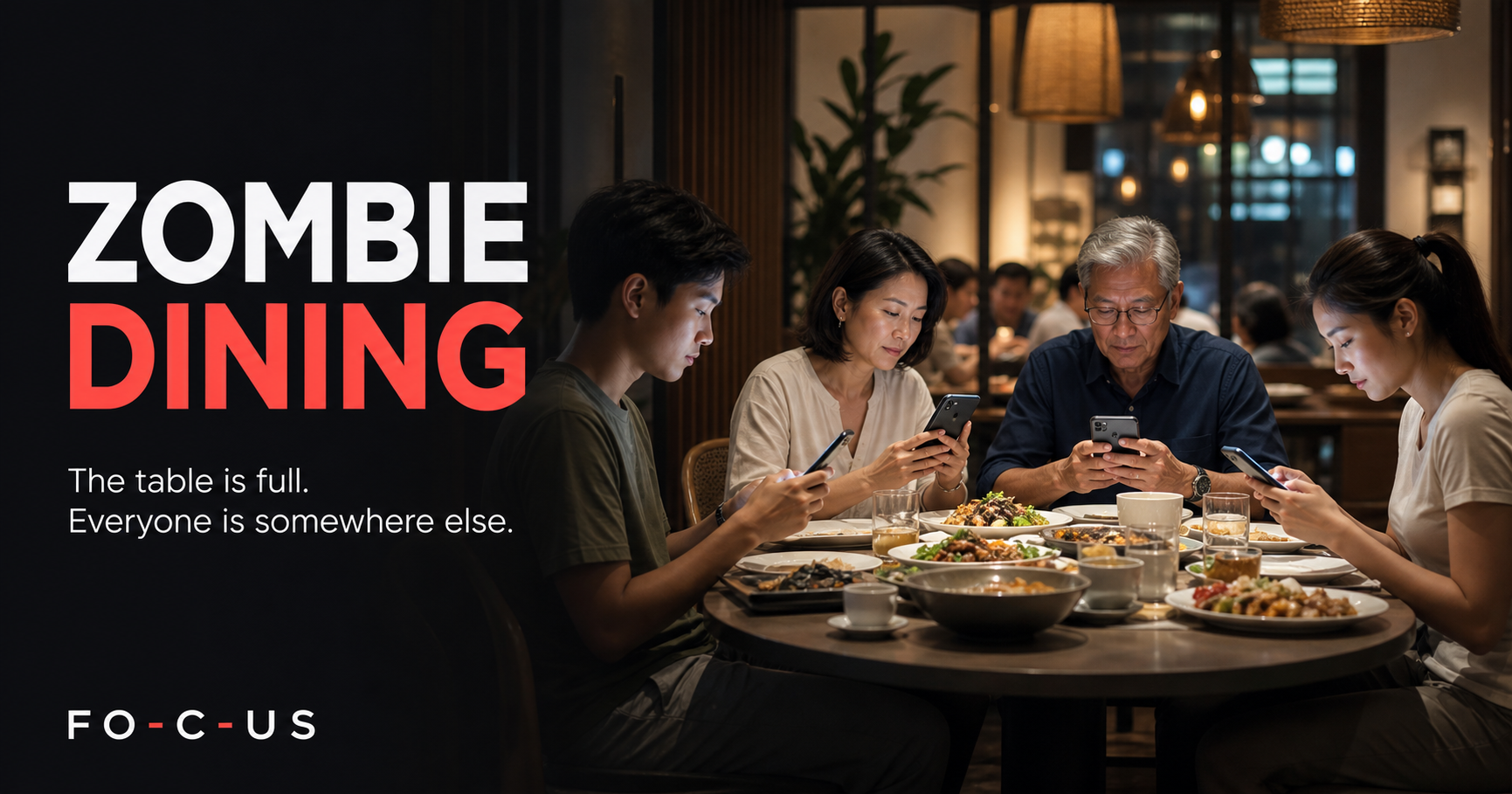
Walk through a busy Singapore restaurant and you may recognise the scene.
A family has made the effort to be in one place. Food covers the table. Four people sit only an arm’s length apart. Yet one person is scrolling, another is watching a video, and someone else is answering messages between mouthfuls.
Nobody is arguing. Nobody has deliberately rejected anyone. That may be why the moment is so easy to miss. The meal is simply passing while each person is somewhere else.
We began calling this scene “zombie dining.”
It is a deliberately uncomfortable phrase—not a label for the people at the table, and not a medical diagnosis. It describes a shared occasion that looks alive from a distance but has quietly surrendered many of its opportunities for interaction.
Perhaps the more uncomfortable question is personal: when the people closest to us remember this season of their lives, will they remember that we were beside them—or that they were often waiting for us to look up?
Sometimes the person across from us is not asking for a profound conversation. They are asking, quietly, to matter more than whatever just appeared on our screen.
The disappearing moments between people
A family meal is not automatically meaningful. People can sit through dinner without having a deep conversation, with or without their phones.
But meals create something valuable: repeated opportunities for small acts of relationship maintenance.
A parent notices that a child is unusually quiet. Someone tells the story behind what happened at work. A joke becomes part of the family’s language. An old memory returns. A misunderstanding softens because people have time to hear the rest of the sentence.
None of these moments looks important while it is happening. Together, they are part of how people come to feel known.
That is what phone absorption may displace. The loss is not merely eye contact or perfect table manners. It is the accumulation of questions not asked, expressions not noticed, and stories postponed until another time.
Think about the people you most want to remain close to. What have they tried to tell you lately that deserved more than half your attention? What expression crossed their face while you were finishing one last message?
These are not questions for producing guilt. Guilt usually makes people defensive. They are questions for noticing what is still available to choose differently.
What research actually shows
The most relevant evidence does not say that every phone ruins every meal. It does suggest that phone use can subtly change the quality of some shared experiences.
In a field experiment involving more than 300 people dining with friends or family, researchers assigned some groups to keep their phones available on the table and others to put them away. Participants who used their phones reported feeling more distracted and enjoying the experience less. The effect was modest, but it appeared in an ordinary social setting rather than an artificial digital detox.
Observational research in fast-food restaurants found very different patterns of caregiver phone use. Some use was brief or shared; other use involved deep individual absorption. The degree of absorption—and how adults responded when children sought their attention—was more informative than simply recording whether a phone appeared.
A later analysis of recorded home mealtimes examined moment-to-moment relationships between maternal device use and parent-child verbal and non-verbal interaction. Its small sample and specific population mean it should not be treated as a verdict on all families, but it reinforces the value of studying what changes during active device use.
Newer research adds another complication. A 2026 study found that phone use during family meals was common in its sample, especially among parents, but motivations included sharing positive moments with a child as well as distraction or emotional regulation. Why a phone is being used deserves attention alongside whether it is being used.
Phones can interrupt or dilute face-to-face interaction, but the effect depends on how, why, and with whom they are being used.
Singapore is already asking the larger question
In May 2026, Singapore’s Ministry of Digital Development and Information launched Screen Smart from the Start, a nationwide effort to help families develop healthier digital habits.
An MDDI survey found that only 37% of parents felt confident managing their children’s digital activities, while more than half wanted more support. Importantly, the programme does not frame the answer as minimising every minute of screen use. It combines practical guidance with meaningful offline experiences, play, and family engagement.
The goal should not be a household in which technology is treated as the enemy. It should be a family capable of choosing when a screen adds to a shared experience and when it is quietly taking one away.
What we still need to observe in Singapore
A useful local study should distinguish no visible device use, brief practical use, shared use such as looking at a photograph together, and individual use that appears to replace interaction for a sustained period.
It should record only aggregate visible behaviour—never names, faces, photographs, audio, conversation content, exact ages, table numbers, bills, or persistent identifiers.
Even then, the result could not tell us whether any particular family is close, happy, or communicating meaningfully. It could answer a narrower question: during sampled shared meals, how often and in what ways did visible phone use occupy the occasion?
Phones are not the villain
A parent may be answering an urgent caregiving message. A child may use a device for communication or accessibility. A family may be showing one another holiday photographs, translating a menu, finding the answer to a shared question, or paying the bill.
A blanket phone ban can create a new problem: one person becomes the enforcer, necessary use becomes suspicious, and the entire meal turns into a test of compliance.
FO-C-US takes a different view. Phones are useful. Shared attention is valuable. The question is whether the people at the table can intentionally choose between them.
The honest test may be simple: did we choose to use the phone, or did the phone choose the moment for us? And if someone we love had something difficult to say, would our posture tell them that this was a safe time to begin?
- Chosen use or automatic use
- Shared use or isolated use
- Necessary use or habitual checking
- A moment intentionally paused or a moment that disappears unnoticed
Try one meal differently
Do not begin by announcing a permanent family rule. Try one small experiment instead. The aim is not to catch anyone failing; it is to discover what becomes possible when everyone feels equally invited back into the room.
- 01Ask
Say, “Could we try putting our phones down together for fifteen minutes?”
- 02Make it equal
Adults and children take part under the same shared agreement.
- 03Keep phones within reach
This is an invitation, not confiscation.
- 04Allow necessary use
Pause without blame if someone needs a device.
- 05Use one good question
Do not turn dinner into an interview.
- 06Stop at the agreed time
Ask whether the group would like to keep going or try it again another day.
When we sit down together, what would help each of us feel that we are worth being fully here for?
You may discover that fifteen minutes feels surprisingly long. You may also discover that nobody misses the phones as much as expected. Either result tells you something useful.
The opposite of zombie dining is not perfect attention
Families are messy. People get tired. Children fidget. Adults carry worries from work. Some meals will be lively and others will be quiet.
The goal is not to manufacture an Instagram version of family connection. It is to protect enough unclaimed space for something real to happen.
One story. One laugh. One answer nobody expected. One moment in which a person looks up and realises they are being listened to.
Relationships rarely change through a single grand gesture. More often, they are shaped by ordinary opportunities that people keep choosing—or keep missing.
Years from now, we may not remember what was on the screen. We may remember who kept asking us questions, who made room for our unfinished stories, and who helped an ordinary meal feel like belonging.
The table is already there. The people have arrived. The question is whether we will let them feel that we have arrived too.
Try the ritual
One meal. Fifteen minutes. One good question. No blame.
Start a private FO-C-US moment. No app or account is required to begin, and FO-C-US does not listen to or record the conversation.
Start a 15-minute moment →Research and context
Sources behind this article
We distinguish experiments, observations, cross-sectional findings, official context, and FO-C-US interpretation. Sources do not imply endorsement of FO-C-US.
- Dwyer, Kushlev & Dunn (2018)Smartphone use undermines enjoyment of face-to-face social interactionsRestaurant field experiment and experience sampling.
- Radesky et al. (2014)Patterns of mobile device use by caregivers and children during meals in fast food restaurantsNaturalistic observation; describes patterns rather than causality.
- Radesky et al. (2024)Maternal Mobile Device Use and Mealtime Interactions With ChildrenDetailed analysis of 47 recorded home mealtimes.
- Lydecker, Dunford & Deierlein (2026)Family Meals in the Digital AgeCross-sectional study; motivation for phone use matters.
- MDDI (2026)Screen Smart from the Start nationwide movementOfficial Singapore policy context and parent survey.
Notes and evidence boundaries
Read with context.
- Image context
FO-C-US editorial concept. The pictured scene is illustrative and does not document a measured Singapore observation.
- Local evidence boundary
Singapore prevalence has not yet been measured by FO-C-US. The local scene is an editorial observation and research question, not a statistic.
- What this does not prove
These studies do not prove that a visible phone means a weak family. They do not tell us how common absorbed phone use is in Singapore restaurants. And they do not show that putting phones away for fifteen minutes will repair a relationship.
- Evidence in progress
FO-C-US has not measured the prevalence of phone-absorbed dining in Singapore. Until a privacy-reviewed observation is complete, this remains a recognised scene and a research question—not a national trend claim.